

Is there an AI Bubble?
By Devon Walsh
I first learned about an AI chatbot known as Chat GPT when I was in college. I did not find many uses for it other than checking the grammar for a paper I was writing. Flash forward three years to today and AI can plan out and book your vacation, suggest home renovations, cross-shop a product across multiple websites, and even build websites from scratch. The uses seem to be endless, but the rapid growth of AI has caused investors to question whether we are entering a “bubble.” There is no clear “yes” or “no” answer, but we can learn a lot by comparing today’s enthusiasm for artificial intelligence to past times when the market was excited about new technologies. To judge whether there are signs of a bubble today, we think three questions matter most:
- Is the technology real, useful, and profitable?
- Are the stock prices reasonable?
- How are companies paying for it?
AI Spending
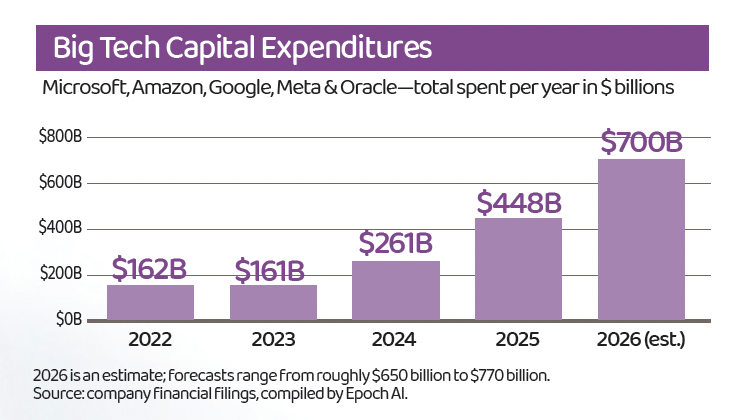
Before we answer the above questions, let’s look at what is currently driving the fear of a stock market bubble. Some of the largest tech companies, Microsoft, Amazon, Google, Meta, and Oracle, combined spent roughly $400 billion on AI systems in 2025 and are expected to spend close to $700 billion in 2026 (according to Goldman Sachs). Most of that money goes toward data centers (giant warehouses full of specialized computers) and the chips that run them. In just the first three months of 2026, AI-related spending hit about $174 billion — up nearly 73% from a year earlier — and made up roughly 42% of the entire U.S. economy’s GDP growth in that period (Chief Equity Strategist Ohsung Kwon with Wells Fargo). This is the largest amount of private money ever poured into one industry in such a short time, and it comes from only a handful of companies. The big question is simple: will all that spending eventually earn a profit? The three questions below help us think it through.
Is the Technology Real, Useful, and Profitable?
In past manias, companies poured money into areas that turned out to have little real demand. For example, 95% of the fiber buildout ended up being unused by 2002 after the dot-com bubble popped. Today the opposite is happening: the computer chips and electricity needed to run AI are in short supply because of massive demand, and customers are signing long-term contracts to reserve that capacity in advance.
While demand is high, actual efficiencies gained from technology are more mixed. In a report published in 2025, the consulting firm McKinsey found that the gains of using AI are real but concentrated: certain software, manufacturing, and marketing teams report cost cuts or revenue lifts of 10–20%, yet most companies aren’t yet seeing meaningful enterprise-wide profit impact yet. Specifically, only 5% of organizations interviewed reported real financial returns (The State of AI in 2025 – McKinsey & Company).
Are the Stock Prices Reasonable? (Valuations)
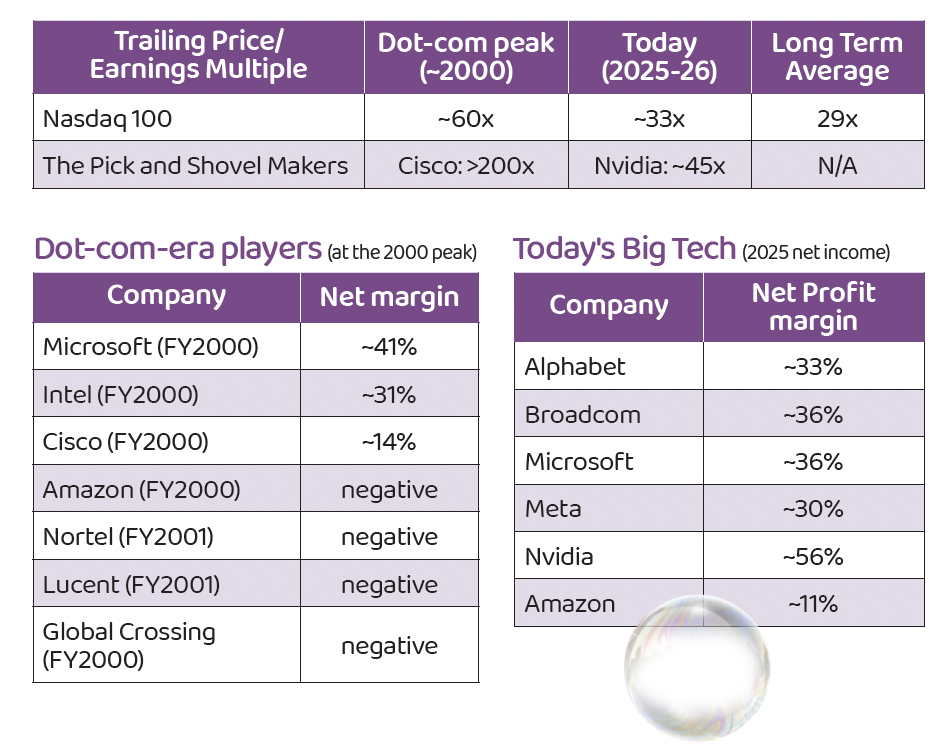
A company’s “valuation” is simply a measure of a stock’s price relative to its revenue or profits. Valuations move day-to-day and price in a company’s growth in the future; investors are willing to pay more for a company that they expect to grow at a faster pace. Today’s big tech stocks are pricier than the historical norm, but nowhere near the extreme levels of the dot-com bubble around 2000, and today’s high fliers have much higher profit margins.
How Are Companies Paying for it? (Financing)
For years, companies like Google, Microsoft, and Meta have built up huge piles of cash, and they are now spending it on the AI buildout. Unlike the phone and internet companies that loaded up on debt before the 2000 crash, today’s giants have mostly been paying with their own cash being generated.
See the debt issued by the major telecom companies in 2000.

Our Conclusion
With my experience in college, I was skeptical about AI, so I decided to spend $20/month on Claude by Anthropic earlier this year; I wanted to get a better idea of what it could do for me. Later that same week, I was having issues with my computer and thought I would consult Claude on the matter. I sent 10,000 lines of code Windows had generated while operating. In a couple of minutes, it parsed through the 10,000 lines and sent back a few lines of code illustrating the issue along with the steps I should take to resolve it. When the issue no longer persisted, I was sold.
Because of the preceding anecdote and many others, we believe that the capabilities of AI are real, perhaps a once-in-a-generation transformational technology. At the same time, valuations today are pricing in incredibly high expectations. At Trust Company of Vermont, we believe in the benefits of diversification. Rather than investing on a single theme, we prefer to spread our investments across numerous sectors, including more “defensive” parts of the market that tend to hold up when the economy struggles. This way, if AI fails to grow at the fast pace priced into certain stocks today, the impact to a portfolio is limited. We believe that AI is truly revolutionary, but as with all quickly changing environments, there will be “winners” and “losers” in the space. Consequently, we focus on what we consider the highest-quality companies both in the technology sector and across many industries that are less prone to dramatic changes.