

How To Invest During A Debt Crisis
By Chris Lafayette, CFA
October 2026
While we can’t know whether a debt crisis will emerge, it doesn’t mean we don’t consider it when investing, and we have contemplated this issue for some time. Before the 2024 election, we wrote that regardless of which party won, the odds of returning to a balanced budget appeared very low. In practice, we have a multipronged approach to positioning for the problems excessive debt might create.
Our first line of defense is avoiding investments that use significant debt. Private Equity, particularly the leveraged buyout segment, relies on large amounts of debt to enhance returns. Additionally, Private Credit has become a popular asset class, but its business is financing debt-heavy transactions. We have avoided both asset classes, to the benefit of recent returns. Through June of 2026, the S&P 500 3-year average annual return was 20.61% vs. 6.68% for the Cambridge US Private Equity Index.
Were a U.S. debt problem to emerge, a likely result would be domestic inflation and a weaker dollar. In this scenario, owning stocks of global businesses has a benefit. Multinational companies generate revenue in numerous countries and currencies. If the dollar declines, foreign earnings become more valuable when converted back into dollars.
U.S. 30 Year Treasury Yield
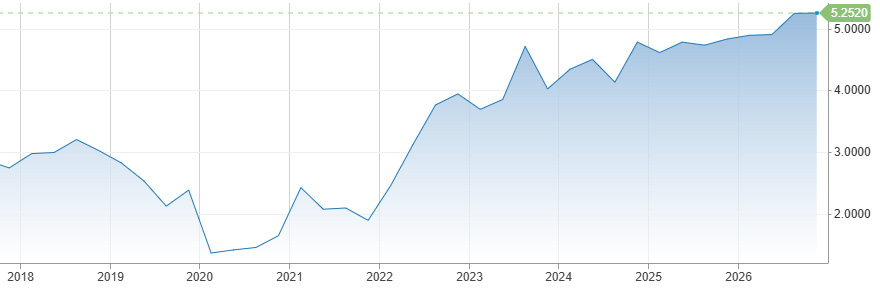
Within the fixed income portion of portfolios, we continue to emphasize short-term, high quality investments. Our average bond maturities extend just a few years, compared with 7+ years for broad bond market indexes. Shorter maturity bonds are less sensitive to rising interest rates and inflationary pressures, allowing us to reinvest sooner if our nation’s creditors demand higher rates of interest.
When it comes to individual stocks, we have always looked for companies with strong balance sheets and manageable debt levels. Companies with less debt generally have more flexibility during periods of economic stress and are less impacted when borrowing costs increase.
Finally, when considering portfolio allocations, we are aware that stocks have historically been among the better long-term hedges against inflation. Businesses can adjust prices for their products as costs rise and can bill customers in whatever currency they choose. If a company wants to charge in dollars, euros, or even something like bitcoin, they have the power to do so, so long as customers demand their product. This reinforces our focus on differentiated business models, with true pricing power.
History suggests it might take a crisis for fiscal policy to change in the United States. For example, Italy went through a debt crisis and was finally forced to cut spending in 2011. However, it’s worth noting that Italian eyewear powerhouse Luxottica, maker of Ray-Ban and Oakley, saw only a muted impact during this time. It benefited from global distribution and a strong balance sheet, resulting in its stock hitting new highs even as the country struggled with slow economic growth.
Importantly, positioning for a potential debt crisis does not require us to deviate from our historic investment approach. There is inherent protection in the way Trust Company of Vermont has always favored a diversified portfolio of high-quality stocks and bonds. So, until we get a crystal ball that works, we will continue to prioritize resilient portfolios, and if there is a financial boogie man keeping you awake at night, ask us. We have very likely considered the risk and a good night’s sleep is a pillar of long-term health.